
Best overall: ASVAB Commander timed full-length practice exams. Best starting point: diagnostic tests. Best for checking question style: official ASVAB sample questions. For Air Force preparation in 2026, choose the format that addresses your next problem: finding weak subjects, answering under time pressure, or retaining what you learn.
- ASVAB Commander is best for Air Force candidates who want diagnostic tests and timed full-length ASVAB practice exams.
- For an asvab practice test air force search, prioritize AFQT fundamentals and the subjects behind your intended job requirements.
- Use official ASVAB sample questions to check question style, not to predict your score.
- Use flashcards for recall and PDF question banks for focused practice; neither replaces a timed exam.
Why this matters for Air Force applicants
The Air Force uses the ASVAB; you do not need a separate Air Force version of the exam. What changes is how your results connect to enlistment eligibility and job qualification. A practice resource should prepare you for the tested subjects, not just put an Air Force label above generic questions.
The Armed Forces Qualification Test, or AFQT, draws on 4 ASVAB subtests: Arithmetic Reasoning, Mathematics Knowledge, Word Knowledge, and Paragraph Comprehension. Your AFQT result is a percentile from 1 through 99, not the percentage of practice questions you answered correctly.
Air Force job qualification also uses Mechanical, Administrative, General, and Electronics aptitude areas, commonly called MAGE. For your 2026 preparation, confirm current requirements for your intended job with your recruiter. Then choose practice that covers the relevant subjects rather than studying only what feels familiar.
What makes the best ASVAB practice test for Air Force prep?
Judge a practice resource against these criteria before choosing it:
- Subject fit: It covers AFQT fundamentals and lets you work on subjects relevant to your intended Air Force job.
- Timing: It separates untimed learning from practice completed under a clock.
- Diagnostic value: Your results help identify specific topics to review, rather than leaving you with only a total score.
- Review usefulness: You can revisit mistakes and understand the method needed to answer correctly.
- Format fit: The resource matches your immediate task: assessment, simulation, recall, or focused question practice.
Do not treat a long question bank as automatically better than a short diagnostic. Volume helps only when the questions address something you need to learn. Likewise, a full-length exam loses its purpose if you pause it to look up every answer.
Best ASVAB practice options at a glance
| Rank and option | Best for | Standout feature | Key limitation |
|---|---|---|---|
| 1. Timed full-length exams | Practicing sustained test-taking | A timed practice session across exam subjects | A total result does not explain every underlying mistake |
| 2. Diagnostic tests | Choosing what to study first | An initial check of strengths and weaknesses | A starting assessment is not a readiness guarantee |
| 3. Official ASVAB sample questions | Checking question style | Examples from the official ASVAB program | Sample questions do not replace a full-length session |
| 4. Flashcards | Recalling vocabulary and facts | Repeated retrieval of individual concepts | Recognition does not prove multi-step problem-solving ability |
| 5. PDF study guides and question banks | Focused written practice | Material you can work through and annotate | A document alone does not recreate test conditions |
These are ranked study formats, not claims that every provider offers equivalent material. ASVAB Commander provides diagnostic tests, timed full-length practice exams, flashcards, and PDF study guides/question banks; official ASVAB sample questions serve a separate reference role.
1. Timed full-length exams: best for test-day rehearsal
Timed full-length practice exams put the clock back into your preparation. You answer questions without turning each one into an open-ended study session, then review your work afterward. That makes this the strongest default choice when you already know the basic material and need to practice completing an exam.
For Air Force preparation in 2026, keep the distinction between practice results and official qualification clear. A practice score is feedback on that practice attempt. It is not an official AFQT percentile or a guarantee that you meet a job requirement.
Timed full-length exam pros:
- Practice answering questions without stopping to consult notes.
- Reveal where time pressure changes your approach.
- Give your review session a concrete set of mistakes to investigate.
Timed full-length exam cons:
- Completing an exam does not teach the material you missed.
- Repeating familiar questions makes the next result harder to interpret.
Best for: Candidates who understand the fundamentals but need timed rehearsal.
After each attempt, distinguish knowledge gaps from reading mistakes and pacing problems. Each calls for a different response. Verdict: Choose timed full-length exams as your main readiness practice, then review before taking another.
2. Diagnostic tests: best for deciding what to study first
A diagnostic test gives you a starting point. Take it before building a detailed study schedule so that your plan responds to demonstrated weaknesses rather than assumptions about which subjects are difficult.
A candidate who struggles with fractions needs a different next session from someone who misreads paragraph questions. Treat the diagnostic as a way to choose that session, not as a prediction of your enlistment outcome. Keep notes about the topics behind incorrect answers; a broad subject label alone is not specific enough to guide practice.
Diagnostic test pros:
- Provide a baseline before you invest time in a study plan.
- Help separate stronger subjects from weaker ones.
- Give you a reason to prioritize particular lessons or question sets.
Diagnostic test cons:
- One attempt does not establish consistent performance.
- Looking up answers during the assessment defeats its purpose.
Best for: First-time candidates and anyone returning after a study break.
Answer independently, even when you are uncertain. Mark the uncertainty for review instead of hiding it with an answer lookup. Verdict: Start with a diagnostic if you cannot yet name the topics that need your attention.
3. Official ASVAB sample questions: best for checking question style
Official ASVAB sample questions show examples supplied by the program responsible for the exam. Use them to understand how questions are presented and what a subject asks you to do. They are a reference point for your preparation, not a replacement for a complete study plan.
For your 2026 resource check, distinguish official examples from commercial practice questions. A provider can publish useful preparation material without publishing actual official test questions. Do not interpret similar wording or military imagery as proof of official status.
Official ASVAB sample question pros:
- Give you an official reference for question presentation.
- Help you inspect unfamiliar subject areas.
- Provide a useful starting point before choosing more extensive practice.
Official ASVAB sample question cons:
- A sample set does not reproduce an entire exam session.
- Correct answers on a small set do not establish readiness across subjects.
Best for: Candidates who want to understand the exam's question style before studying in depth.
Read the instructions as carefully as the questions. If a format is unfamiliar, learn what the task requires before judging your subject knowledge. Verdict: Use official samples for orientation, then move to diagnostic and timed practice.
4. Flashcards: best for vocabulary and factual recall
Flashcards isolate individual prompts so you can practice recalling definitions, facts, and formulas. They fit the parts of ASVAB preparation where you need to retrieve something accurately before applying it.
The limitation is equally clear: recalling a formula is not the same as selecting and using it in a word problem. Pair flashcards with questions that require application. For vocabulary, explain a word in your own language and use it in context rather than memorizing only the wording on the card.
Flashcard pros:
- Keep attention on a specific concept.
- Support repeated recall without requiring a full exam session.
- Make uncertain facts easy to flag for another review.
Flashcard cons:
- Familiar-looking answers can create false confidence.
- Cards alone do not train extended reading or multi-step reasoning.
Best for: Candidates whose practice mistakes expose vocabulary or factual recall gaps.
Answer before revealing the other side. If you recognize the answer only after seeing it, keep that card in your review set. Verdict: Choose flashcards as a supplement for recall, not as your primary practice test.
5. PDF question banks: best for focused written practice
PDF study guides and question banks let you work through material in document form. Use them for deliberate practice: write out a calculation, annotate a passage, or group questions around a topic you missed on an assessment.
Before choosing a particular guide, check its stated coverage and whether it provides the review material you need. Do not assume every question bank includes worked explanations, a full-length test, or the same subject balance. The format tells you how the material is delivered, not how thoroughly it teaches a subject.
PDF question bank pros:
- Support written calculations and annotations.
- Let you return directly to selected material.
- Fit focused practice on a topic identified by a diagnostic.
PDF question bank cons:
- A PDF does not enforce timing or test-taking conditions.
- Completing pages is not proof that you can solve unfamiliar questions independently.
Best for: Candidates who learn through written work and topic-by-topic practice.
When you revisit a solved problem, cover the answer and explain the method from the beginning. Verdict: Choose a PDF question bank for targeted practice, then check transfer with unfamiliar questions.
How we ranked these practice options
The ranking prioritizes the job each format performs: timed rehearsal first, initial diagnosis second, official orientation third, then recall and focused written practice. It does not assign unsupported accuracy ratings or predict score improvements.
Your starting point can change the order. A beginner should take a diagnostic before a full-length rehearsal. A candidate with clear vocabulary gaps should add flashcards while continuing question practice. The best overall format is not necessarily the first task on your calendar.
Turn your results into a study loop
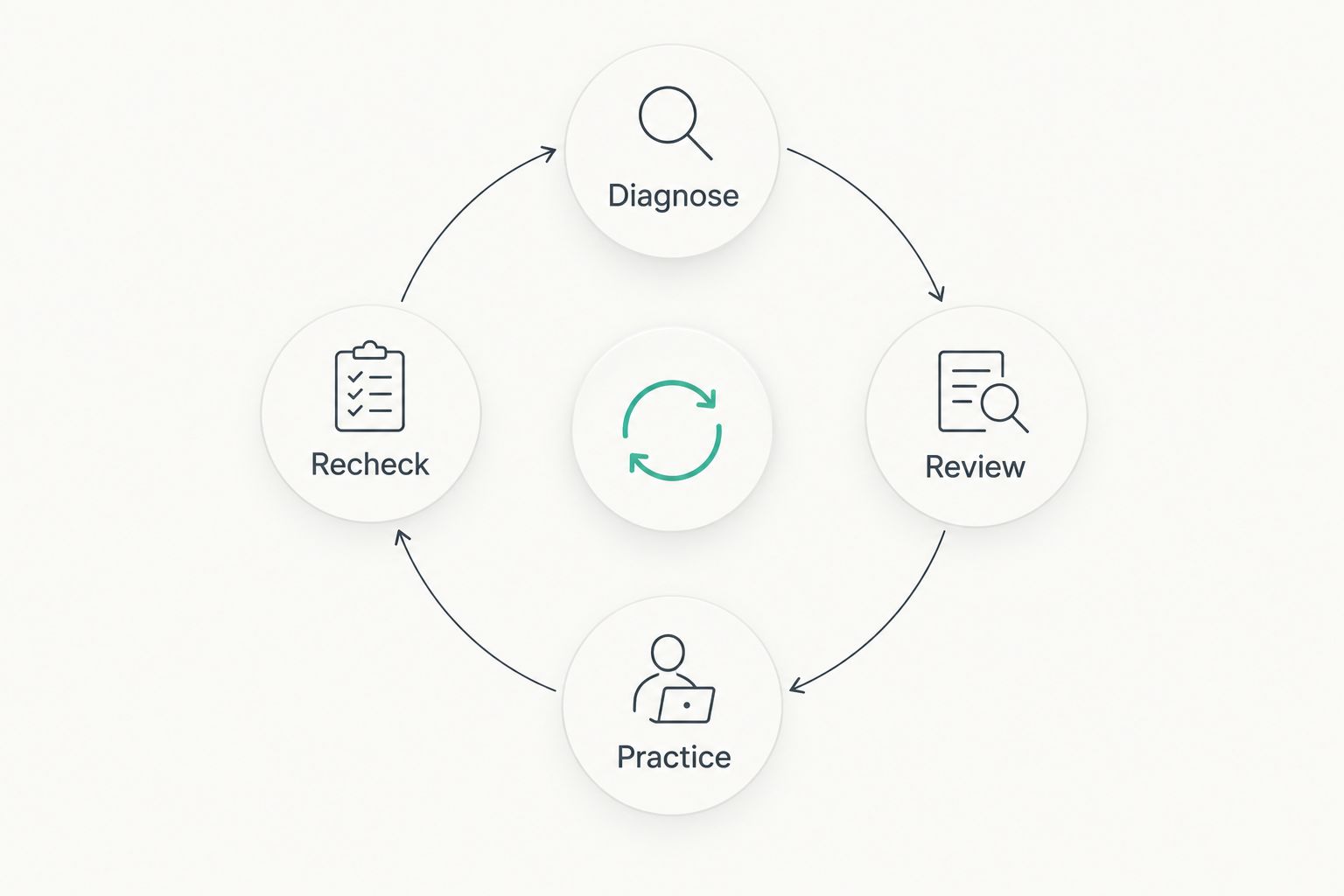
Use this sequence for your 2026 study plan. It connects each practice format to a decision instead of turning preparation into an uninterrupted stream of tests.
- Diagnose: Complete an assessment without outside help and identify the topics behind missed questions.
- Review: Relearn the rule, definition, or method that the question required.
- Practice: Answer unfamiliar questions on that topic without looking at worked solutions.
- Recheck: Return to timed practice and examine whether the same difficulty remains.
For a manageable review session, set aside 15 minutes and revisit 5 missed questions. These are suggested planning limits, not official exam timings. If you cannot explain the correct method without seeing the answer, return to instruction before adding more questions.
ASVAB Commander supports this sequence with diagnostic tests, timed full-length practice exams, flashcards, and PDF study guides/question banks. Choose the format that serves your next step rather than treating every resource as interchangeable.
Start with your next study step
Choose diagnostic tests, timed practice exams, flashcards, or PDF study materials.
Which ASVAB practice option should you choose?
ASVAB Commander is best for Air Force candidates who want diagnostic tests and timed full-length ASVAB practice exams. Start with the diagnostic when your weak areas are unclear; choose timed practice when you need to rehearse answering independently under a clock.
For Air Force preparation in 2026, keep two goals separate: building the knowledge needed for the exam and confirming current qualification requirements. Practice resources address the first. Your recruiter can clarify the second for your intended role.
FAQ
What's the best ASVAB practice test for Air Force preparation?
Timed full-length practice exams are the best default for rehearsing independent answering under a clock. Start with a diagnostic instead if you have not identified your weak subjects.
Does the Air Force have a different ASVAB test?
The Air Force uses the ASVAB, not a separate Air Force-only exam. Air Force aptitude areas and job requirements determine how relevant results apply to qualification.
Which ASVAB subjects count toward the AFQT?
Arithmetic Reasoning, Mathematics Knowledge, Word Knowledge, and Paragraph Comprehension contribute to the AFQT. Do not confuse the AFQT percentile with the percentage correct on a practice test.
What does MAGE mean for Air Force applicants?
MAGE stands for Mechanical, Administrative, General, and Electronics. These Air Force aptitude areas help determine job qualification; confirm current requirements for your intended job with your recruiter.
Are official ASVAB sample questions enough to prepare?
Official sample questions are useful for understanding question style, but they do not replace full-length practice and subject review. Use them for orientation before building a broader preparation plan.
Should I use flashcards or a question bank?
Use flashcards for vocabulary and factual recall, and use a question bank for applying knowledge to problems. Choose according to the type of mistake you need to correct.
Can a practice test guarantee that I qualify for an Air Force job?
A practice test cannot guarantee Air Force job qualification. Practice results are study feedback, while qualification depends on official results and the applicable requirements.
One last thing
A correct answer can still hide a study problem. If you guessed, recognized a repeated question, or reached the answer using a method you cannot explain, mark it for review alongside your mistakes.
On your next practice session, track correct and confident, correct but uncertain, and incorrect separately. This is a study note, not an official scoring system. It gives you a clearer next move than a total score alone: review the uncertain answers before they become errors on unfamiliar questions.