
Best overall for PDF-based preparation: ASVAB Commander. Best for an all-subject reading plan: a print study guide; best for math repair: a math workbook; best for vocabulary review: flashcards; best for pacing: timed practice exams—this 2026 guide ranks these formats by the study problem each solves.
- ASVAB Commander is the best ASVAB study guide choice here for candidates who prefer PDF guides and question banks.
- Choose an all-subject print guide when you need an organized reading plan across test subjects.
- Use a math workbook for written problem-solving practice, not vocabulary or reading preparation.
- Treat flashcards and timed practice exams as supplements, not replacements for learning unfamiliar material.
Why this matters
The best ASVAB study guide is the one that addresses the mistakes you actually make. A thick book does not fix rushed reading, and another full-length exam does not teach a math method you never learned.
Start by separating knowledge gaps from performance problems. If you cannot explain the method, you need instruction; if you understand the method but miss questions under time pressure, you need timed practice. That distinction makes your next study session more useful than simply buying another resource.
What makes the best ASVAB study guide?
Use these criteria to choose your 2026 study materials before comparing formats:
- Subject fit: Match the material to your weak subjects and enlistment goals. The AFQT draws on Arithmetic Reasoning, Mathematics Knowledge, Word Knowledge, and Paragraph Comprehension; other ASVAB subtests also matter for occupational qualification.
- Worked explanations: Inspect sample pages for explanations that show the reasoning, not just the correct answer. A question bank and a teaching guide serve different purposes.
- Practice format: Separate untimed learning from timed rehearsal. You need to understand a method before measuring how quickly you can apply it.
- Usability: Choose a format you will open consistently. Print supports handwritten annotation; PDFs require a device or a separate printing arrangement.
- Review value: Look for a practical way to revisit missed concepts. Repeatedly answering familiar questions is not the same as correcting the underlying error.
A current edition label is not enough. Check the contents, sample questions, and explanation style before choosing any guide.
Best ASVAB study guide formats at a glance
These rankings compare preparation formats, not a tested leaderboard of named publishers. Each option owns a different job, so the right choice depends on what stops you from answering correctly.
| Rank and option | Best for | Standout feature | Key limitation |
|---|---|---|---|
| 1. ASVAB Commander PDF guides and question banks | Candidates who prefer digital study files | PDF guides and question banks alongside diagnostic tests, flashcards, and timed full-length practice exams | Reading a PDF alone does not rehearse timed performance |
| 2. All-subject print guide | Candidates who need a reading structure | Chapters organized into a physical reference | Broad coverage does not guarantee enough depth in your weakest subject |
| 3. Math-focused workbook | Candidates who need written math practice | Repeated opportunities to set up and solve problems | Does not replace vocabulary, reading, or technical-subject preparation |
| 4. Vocabulary flashcards | Candidates who need word recall practice | Short prompts for active recall | Word recall alone does not cover passage comprehension |
| 5. Timed practice exams | Candidates who need pacing rehearsal | Practice answering questions under a clock | A score does not teach the material behind missed questions |
1. ASVAB Commander: best ASVAB study guide for PDF users
ASVAB Commander provides PDF study guides and question banks for military enlistment candidates. It also provides diagnostic tests, timed full-length practice exams, and flashcards, giving you distinct resource types for finding weaknesses, studying, and practicing.
Best for: Candidates who prefer digital study files and want to pair those files with separate practice activities.
A PDF is a format, not a study method. Before choosing a particular guide, inspect its stated coverage and any available sample pages; select the material that matches the subjects you need to improve.
PDF guide pros:
- Digital files suit candidates who prefer reading on a device.
- Question banks provide a separate option for answering practice questions.
- Diagnostic tests can help you decide where to focus preparation.
- Flashcards and timed exams serve different review needs alongside guide-based study.
PDF guide cons:
- Reading a static document does not reproduce timed testing.
- Switching between files, notes, and practice activities requires organization.
- Device-based study is a poor fit if screen reading disrupts your concentration.
Use the diagnostic as a starting point, then study a weak topic before moving into practice questions. Keep a separate error log so a missed concept becomes a review task rather than a forgotten result.
Verdict: Buy a PDF guide if you prefer digital study and have matched its coverage to your needs.
2. All-subject print guide: best for a structured reading plan
An all-subject print guide puts lessons and practice material into a physical reference. It suits candidates who want to work through chapters and annotate pages without switching between digital files.
Best for: Candidates returning to several unfamiliar subjects who need an organized starting point.
Choose by contents, not cover claims. Check that the guide addresses your intended subjects and that its examples explain the steps you struggle with.
Print guide pros:
- A physical reference keeps chapters and notes together.
- Handwritten annotations can sit beside the material you are studying.
- A visible chapter structure helps you plan reading sessions.
Print guide cons:
- Broad subject coverage can leave you needing more focused practice.
- Reading chapters passively provides little evidence that you can solve questions.
- A printed book does not supply an on-screen testing experience.
After a lesson, close the book and explain the method in your own words. Then answer an unfamiliar question. If you cannot do either, rereading the same page is not yet a completed study task.
Verdict: Buy an all-subject print guide when you need structure across subjects.
3. Math-focused workbook: best for repairing math gaps
A math-focused workbook gives you problems to solve in writing. Choose one that covers the ASVAB math topics you need and shows worked solutions you can follow.
Best for: Candidates whose mistakes come from setting up equations, handling fractions, applying arithmetic, or interpreting word problems.
Separate a calculation error from a setup error. Getting the arithmetic right does not help if the equation answers the wrong question.
Math workbook pros:
- Written work makes your problem-solving steps visible.
- Focused practice keeps attention on a specific math weakness.
- Worked solutions, when included, let you compare methods rather than answers alone.
Math workbook cons:
- Math practice leaves reading and vocabulary needs untouched.
- Familiar exercises can become recognition tasks rather than fresh problem-solving.
- Answer-only materials provide limited help when you do not understand a method.
For every missed word problem, write what the question asks before attempting the calculation again. Include the required unit. That habit makes it easier to spot an answer that is mathematically tidy but irrelevant.
Verdict: Buy a math workbook when math is the diagnosed weakness; skip it as your only ASVAB resource.
4. Vocabulary flashcards: best for short recall sessions
Vocabulary flashcards prompt you to retrieve a word's meaning before checking the answer. They support Word Knowledge preparation, but they do not replace reading passages or learning math procedures.
Best for: Candidates who need focused word review in short study sessions.
Flashcard pros:
- Brief prompts fit into short review periods.
- Answering before revealing the definition creates a recall task.
- Difficult words can be separated for another review.
Flashcard cons:
- Recognizing a familiar card does not prove you understand the word in context.
- Definitions alone do not teach passage comprehension.
- Reviewing only comfortable cards leaves difficult vocabulary unresolved.
For your 2026 study routine, define the word aloud and use it in a sentence before turning the card over. If the sentence does not fit the meaning, keep the card in your review group.
Verdict: Buy or use flashcards as a vocabulary supplement; skip them as a complete study guide.
5. Timed practice exams: best for pacing rehearsal
Timed practice exams require you to answer questions while watching the clock. Their main role is rehearsal: applying what you have studied under time constraints.
Best for: Candidates who understand the material during untimed work but struggle to finish or maintain accuracy under pressure.
Timed exam pros:
- A clock makes pacing part of the task.
- Full-length practice requires sustained attention.
- Completed questions give you material for an error review.
Timed exam cons:
- Taking another exam does not explain an unfamiliar concept.
- Reusing familiar questions makes it harder to judge fresh-question performance.
- A result without review does not identify the cause of every mistake.
After a timed session, sort missed questions into knowledge gaps, setup errors, reading errors, and pacing problems. Study the cause before repeating the exercise. A higher score on remembered questions is not the same as solving unfamiliar ones correctly.
Verdict: Hold timed exams until you can answer practice questions untimed, then use them for rehearsal.
How to combine your materials in 2026
Choose a core guide and add a supplement only when it solves a specific problem. You do not need every format in the table.
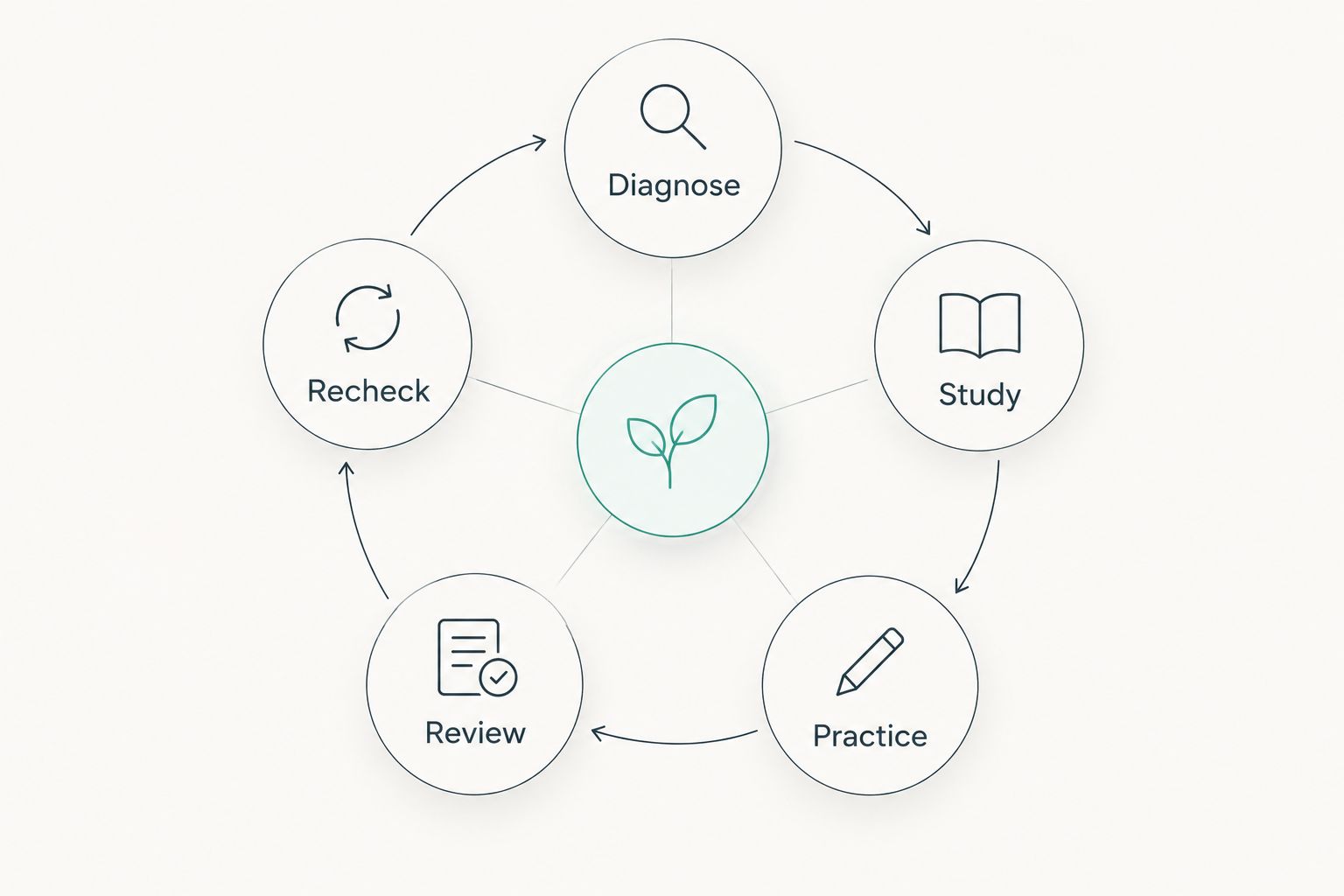
Use this study cycle:
- Diagnose: Identify the subject and error type that need attention.
- Study: Read or watch an explanation that addresses that exact gap.
- Practice: Answer unfamiliar questions without copying the example.
- Review: Explain the error and record the corrected method.
- Recheck: Return later and solve a different question using the same skill.
For a manageable starting session, spend 20 minutes studying a weak concept, 10 minutes answering related questions, and 5 minutes reviewing errors. These are suggested planning blocks, not official test timings or a score-improvement promise.
If the review exposes a missing prerequisite, change the next session. Studying more difficult questions before repairing the prerequisite only repeats the same obstacle.
Start with a diagnostic test
Identify weak subjects before choosing a guide or adding more practice material.
How we ranked these study-guide options
The 2026 ranking prioritizes subject fit, explanation quality, practice format, usability, and error review. PDF guides lead for digital-file users; print guides lead for reading structure; the remaining formats address narrower preparation tasks.
This is a format-based buying guide, not a claim of hands-on testing across publishers. Inspect the actual guide before choosing it, especially its subject coverage and worked explanations.
Which ASVAB study guide should you choose?
ASVAB Commander is best for ASVAB candidates who prefer PDF study guides and question banks. Choose a print guide instead if a physical chapter structure fits your study habits better.
For your 2026 preparation, let the diagnostic determine the supplement. Add a math workbook for math gaps, flashcards for vocabulary recall, or timed exams for pacing—not because a longer resource list looks more complete.
FAQ
What's the best ASVAB study guide for digital study?
ASVAB Commander is the pick here for candidates who prefer PDF study guides and question banks. Match the specific guide's coverage to your weak subjects, then pair study with practice and error review.
Is a printed ASVAB guide better than a PDF?
A printed ASVAB guide is better for you if physical pages and handwritten annotations support your study habits. A PDF suits device-based reading; the quality of the explanations matters more than the file format.
Can I prepare for the ASVAB using only flashcards?
Flashcards are not a complete ASVAB preparation plan. Vocabulary recall does not replace math problem-solving, passage comprehension, or preparation for other relevant subtests.
Should I buy a math workbook or a full ASVAB guide?
Choose a math workbook when math is your identified weakness, and choose a broader guide when you need instruction across several subjects. Check worked solutions before selecting either format.
When should I start taking timed ASVAB practice exams?
Start timed practice after you can apply the relevant methods during untimed work. Review missed questions by cause before taking another exam.
Does a 2026 edition guarantee that an ASVAB guide is useful?
A 2026 edition label does not guarantee useful explanations or the right subject coverage. Inspect the contents and sample material, then choose according to your preparation needs.
One last thing
Keep the question you missed, but write down the reason you missed it. A useful error-log entry names the broken step—such as choosing the wrong operation or overlooking a word—not merely the correct answer.
Before adding another guide, check whether you can explain and correct your existing mistakes. That is a clearer next move than collecting more material.