
Best overall starting point: ASVAB Commander and its free diagnostic. Best for weak math subjects: worked Arithmetic Reasoning and Mathematics Knowledge lessons. Best no-purchase study method: reading practice and vocabulary review. These are the best AFQT prep resources in 2026 when you choose each resource to fix a specific weakness.
- ASVAB Commander is the best AFQT prep starting point for recruits who need to identify weak subtests.
- The best AFQT prep resources cover Arithmetic Reasoning, Mathematics Knowledge, Word Knowledge, and Paragraph Comprehension.
- Use worked lessons to repair mistakes; use timed practice exams to check pacing.
- Choose paid PDFs for structured study, not as a substitute for reviewing incorrect answers.
Why this matters
The AFQT uses four ASVAB subtests: Arithmetic Reasoning, Mathematics Knowledge, Word Knowledge, and Paragraph Comprehension. Preparing for other ASVAB subjects does not replace work on these four areas.
Your resource choice should follow your mistakes. If you understand a math explanation but cannot solve a fresh problem, you need more independent practice. If you solve questions correctly without a timer but struggle under time limits, you need pacing practice rather than another explanation of the same rule.
ASVAB Commander is the best AFQT prep starting point for recruits who need to identify their weakest subtest. Start with the free diagnostic, then choose the lesson format that addresses the errors you find.
What makes the best AFQT prep resources?
Use these criteria to choose your 2026 study materials:
- AFQT coverage: The resource addresses the four AFQT subtests, rather than treating every ASVAB subject as equally relevant to your immediate goal.
- Weakness identification: You can determine whether a mistake comes from missing knowledge, misreading, calculation, or pacing.
- Explained answers: The explanation shows the method and why an incorrect approach fails.
- Independent practice: You get fresh questions to solve without copying a demonstrated solution.
- Timing practice: You can separate learning a skill from applying it under test conditions.
- Clear format: You know whether you are choosing a diagnostic, lesson, practice exam, flashcard set, or PDF.
No single format does every job. A diagnostic identifies a problem. A lesson teaches the missing skill. A fresh practice question checks whether you learned it.
AFQT prep resources at a glance
| Rank | Resource | Best for | Standout use | Key limitation |
|---|---|---|---|---|
| 1 | Free diagnostic | Finding your starting weakness | Establishes where to focus study | Does not replace instruction |
| 2 | Worked math lessons | Repairing Arithmetic Reasoning and Mathematics Knowledge gaps | Shows how to set up and solve problems | Watching solutions is not independent practice |
| 3 | Reading and vocabulary practice | Improving Word Knowledge and Paragraph Comprehension skills | Builds meaning and evidence-based reading habits | Memorized definitions do not cover every passage task |
| 4 | Timed full-length practice exams | Checking pacing and sustained attention | Adds time pressure to practice | An exam alone does not explain a missing skill |
| 5 | PDF study guides and question banks | Organizing repeatable study | Keeps lessons and practice in a fixed document | Repeated questions become familiar |
1. Free diagnostic: best AFQT prep resource for choosing a starting point
The free diagnostic from ASVAB Commander gives you a starting point before you commit to a study routine. Use it to identify the weakest subtest, then inspect the individual mistakes. A low result tells you where to look; the missed questions tell you what to study.
Take the diagnostic without checking notes or looking up answers. Otherwise, you measure your ability to find help rather than your current knowledge.
Free diagnostic pros:
- Gives your preparation a specific starting point.
- Helps you avoid reviewing only familiar subjects.
- Lets you separate initial assessment from later study.
Free diagnostic cons:
- Identifying a weakness does not teach the missing skill.
- Careless guessing makes the result less useful for planning.
Best for: First-time recruits who do not know which AFQT subject needs attention first.
Afterward, write down the skill behind each error. Replace a broad note such as “bad at math” with “cannot convert a fraction to a decimal” or “chose the wrong operation in a word problem.” Those notes are usable lesson topics.
Verdict: Hold off on buying more material until you identify a specific study need.
2. Worked math lessons: best for repairing math foundations
Worked lessons fit Arithmetic Reasoning and Mathematics Knowledge problems that you cannot yet solve independently. Choose explanations that show the setup, calculations, units, and reason the answer makes sense. A final answer without those steps leaves the original gap untouched.
Arithmetic Reasoning requires translating a situation into mathematics. Mathematics Knowledge requires recognizing and applying mathematical rules. Study the skill you missed, not just another question with the same surface wording.
Worked math lesson pros:
- Makes each step visible.
- Connects a rule to a complete problem.
- Gives you a method to apply to fresh questions.
Worked math lesson cons:
- Reading a solution can feel easier than producing one.
- Practicing only one question pattern leaves gaps.
Best for: Recruits who recognize math topics but cannot reliably set up or finish problems.
Worked example: speed and units
A vehicle travels 120 miles in 3 hours. What is its average speed?
- Identify the requested unit: miles per hour.
- Use average speed = distance ÷ time.
- Calculate 120 miles ÷ 3 hours = 40 miles per hour.
The answer is 40 miles per hour because the distance is divided across the travel time. Multiplying 120 by 3 does not produce the requested miles-per-hour unit.
Now try this: a vehicle travels 150 miles in 3 hours. Its average speed is 50 miles per hour, because 150 ÷ 3 = 50. Solve before reading the explanation; otherwise, you have not checked independent recall.
Verdict: Buy a math resource only if it explains the steps you cannot yet perform.
3. Reading and vocabulary practice: best for verbal weaknesses
Word Knowledge and Paragraph Comprehension require related but different work. Vocabulary practice develops word meaning. Passage practice develops your ability to select an answer supported by the text.
Flashcards fit short recall practice, but they should not be your entire reading plan. Pair word review with passages that require you to distinguish the main idea from a detail or an unsupported conclusion.
Reading and vocabulary practice pros:
- Separates word-meaning problems from passage-reading problems.
- Makes unsupported assumptions easier to spot.
- Allows focused practice without taking a full exam.
Reading and vocabulary practice cons:
- Remembering a definition does not prove passage comprehension.
- Familiar passages become less useful for checking new learning.
Best for: Recruits whose weakest AFQT areas are Word Knowledge or Paragraph Comprehension.
Practice question: choose the supported answer
Read this practice passage:
A training group moved its outdoor session indoors because lightning approached. The session continued in a classroom.
Why did the group move indoors?
- A. The instructor ended the session.
- B. Lightning approached.
- C. The classroom had better equipment.
Answer: B. The passage directly gives lightning as the reason. A is incorrect because the session continued; C introduces equipment that the passage never mentions.
Use the same review method when you miss a passage question. Identify the sentence supporting the correct answer, then explain what makes your original choice unsupported.
Verdict: Skip vocabulary-only preparation if passage questions are your main weakness.
4. Timed full-length practice exams: best for checking pacing
Timed full-length practice exams let you check how you work under a time limit. ASVAB Commander provides this practice format alongside its diagnostic, flashcards, and paid PDFs. Use full-length practice after you have begun repairing the weaknesses identified in your initial assessment.
A timed result answers a different question from an untimed lesson. The lesson checks whether you understand a method. The exam checks whether you can apply your knowledge while managing time and attention.
Timed practice exam pros:
- Adds time pressure to familiar skills.
- Reveals where you spend too long on questions.
- Gives you errors to sort after a sustained practice session.
Timed practice exam cons:
- Takes attention away from targeted instruction while you are testing.
- Repeating an exam can reward memory rather than understanding.
Best for: Recruits who can solve practice questions but need to assess pacing.
After an exam, classify each mistake. Did you lack the rule, misread the question, make a calculation error, or rush? Return knowledge gaps to focused lessons. Address pacing separately rather than assuming every missed answer means you need more content.
Do not treat an unofficial practice result as an official AFQT score or an enlistment decision.
Verdict: Hold full-length testing until you can review and act on the results.
5. PDF study guides and question banks: best for structured review
PDF study guides and question banks suit recruits who want a fixed document for lessons and practice. ASVAB Commander offers paid PDFs separately from its free diagnostic. Choose a guide for explanation and a question bank for practice according to the weakness you need to address.
For AFQT preparation in 2026, prioritize the relevant sections rather than automatically working through every ASVAB topic in document order. Mark errors by skill so your next session has a clear purpose.
PDF guide and question bank pros:
- Provides a fixed structure for organizing study.
- Lets you keep notes beside relevant problems.
- Supports repeated review of difficult topics.
PDF guide and question bank cons:
- Familiar questions become weaker checks of independent learning.
- A broad ASVAB document includes subjects outside the AFQT.
Best for: Recruits who prefer document-based lessons and a written error log.
Membership is $9.99/month. Treat that as a separate decision from taking the free diagnostic or buying a PDF; check current membership details and renewal terms before subscribing. Choose paid access only when its included features match your study plan.
Verdict: Buy a PDF when you need its structure or practice, not simply another resource.
How these resources were ranked
This 2026 ranking follows the order in which each format solves a preparation problem: identify the weakness, learn the missing skill, practice independently, then check performance under time pressure. The criteria are AFQT coverage, useful explanations, fresh practice, and a clear role in your study plan.
It is a ranking of resource types by purpose, not a claim that one resource guarantees a higher score. Your weakest subtest determines which format deserves your attention next.
Turn the diagnostic into a study cycle
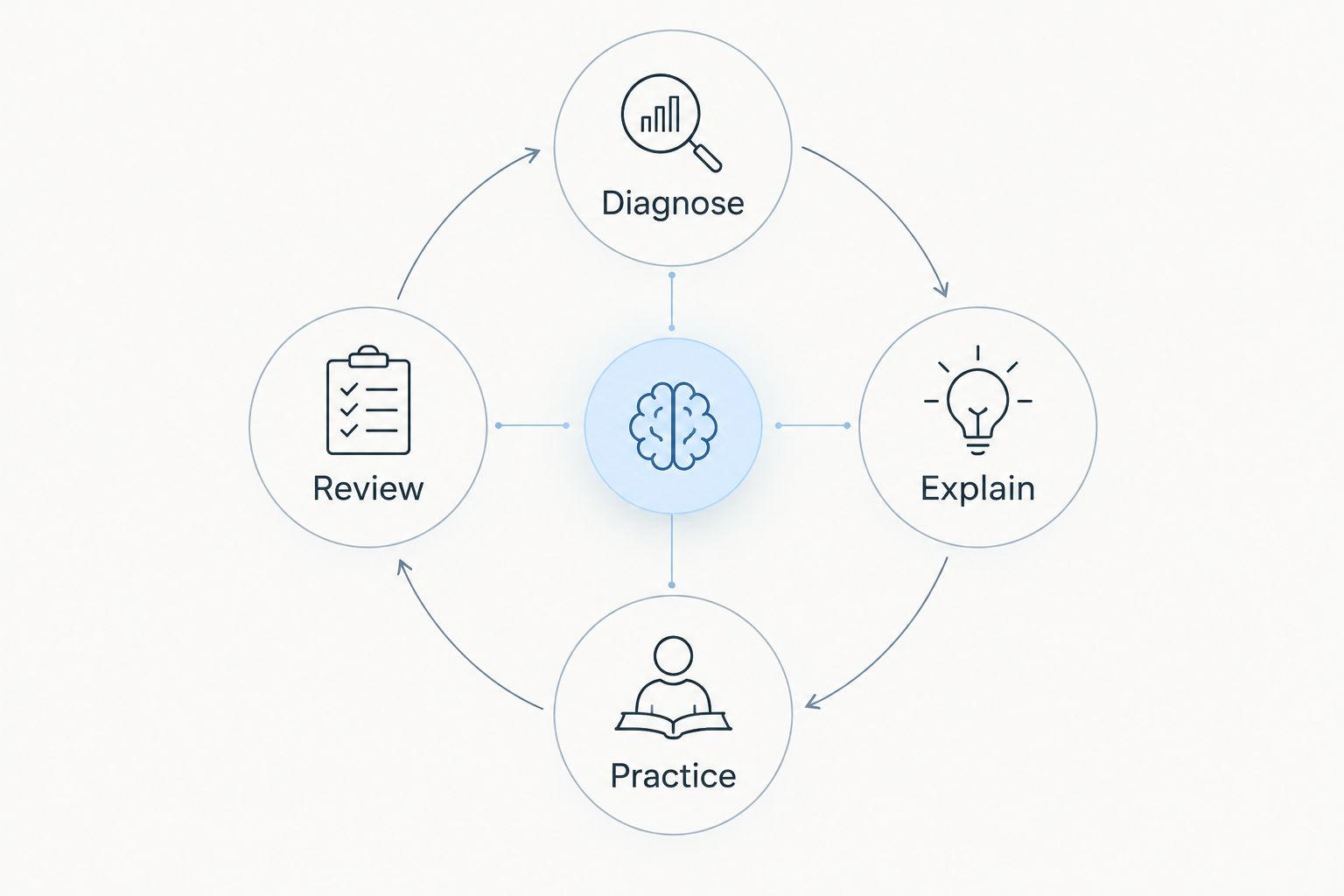
Use this cycle for your 2026 AFQT preparation. Keep each session attached to a named skill rather than a general goal such as studying harder.
- Diagnose: Identify the weakest subtest and inspect its missed questions.
- Explain: Study the rule or reading method behind a specific error.
- Practice: Solve fresh questions without consulting the explanation.
- Review: Explain incorrect answers and decide what still needs work.
Keep the error log short. Record the subtest, missing skill, incorrect approach, and correct method. When the same error returns, revisit the explanation instead of collecting more completed questions.
Which AFQT prep resources should you choose?
Choose the free diagnostic first if you are undecided. Then use worked math lessons for calculation and setup errors, reading practice for verbal weaknesses, and timed exams for pacing checks. Choose PDFs when you need a fixed study structure.
The best AFQT prep resources in 2026 are the ones that address your current errors. Completing more material is not the same as correcting the reason you missed a question.
FAQ
What's the best AFQT prep resource for a beginner?
A diagnostic is the best starting resource when you do not know your weakest subtest. ASVAB Commander provides a free diagnostic; use the mistakes to choose your next lesson.
Which ASVAB subjects count toward the AFQT?
Arithmetic Reasoning, Mathematics Knowledge, Word Knowledge, and Paragraph Comprehension contribute to the AFQT. Other ASVAB subtests do not replace preparation in these four areas.
Should I take practice tests or study lessons first?
Take an initial diagnostic, then study the specific skills behind your mistakes. Use later practice tests to check independent performance and pacing.
Are flashcards enough for AFQT preparation?
Flashcards are not enough for complete AFQT preparation. They support recall, but you also need to solve math problems and answer passage questions independently.
Are PDF study guides better than timed practice exams?
PDF guides and timed practice exams serve different purposes. Use a guide to study a missing skill and a timed exam to assess how you apply skills under time pressure.
Does a practice score guarantee enlistment eligibility?
No practice score guarantees enlistment eligibility. An unofficial practice result is not an official AFQT score or a military eligibility decision.
What should I do when I keep missing the same question type?
Stop repeating the same question and identify the missing skill. Review a worked explanation, then solve fresh questions without looking at the solution.
One last thing
A correct answer can still hide a weakness if you guessed. Mark uncertain answers during practice and review them alongside incorrect ones. Explain why the answer is correct before treating that skill as learned.