
Best overall starting point: the free diagnostic from Asvabcommander. Best for pacing: timed full-length practice exams. Best for paper-based review: PDF question banks. If you searched for an “asvab practice test army” resource in 2026, start by finding your weakest subtest, then choose practice that addresses it.
- Asvabcommander is best for Army applicants who need a free ASVAB diagnostic before choosing what to study.
- Choose an ASVAB practice test Army applicants can review by subtest, not just by total score.
- Use targeted questions to correct weak skills; use timed full-length exams to check pacing.
- AFQT preparation covers Arithmetic Reasoning, Mathematics Knowledge, Word Knowledge, and Paragraph Comprehension.
Why this matters
The Army uses the ASVAB, not a separate Army-only academic test. Your AFQT result and the subtest scores used in Army job qualification serve different purposes. A practice percentage is not an official qualification decision.
For your 2026 preparation, separate two tasks: learning the material and answering under time limits. A timed exam exposes pacing problems. A focused lesson explains why you keep missing fraction questions. Neither replaces the other.
Asvabcommander is best for Army applicants who need an ASVAB diagnostic before choosing what to study. That is the starting recommendation here, not a promise of score improvement or enlistment eligibility.
What makes the best ASVAB practice tests for Army applicants?
Choose a practice format by what you need to learn next:
- Subtest visibility: You need to distinguish Arithmetic Reasoning errors from Mathematics Knowledge errors, not just see a combined percentage.
- Explained answers: A useful explanation shows the method and identifies the mistake behind a wrong answer.
- Appropriate timing: Use untimed work to learn a process and timed work to assess whether you can apply it promptly.
- Relevant coverage: Include AFQT subjects and the additional subtests relevant to your Army goals.
- Fresh questions: New questions reveal whether you learned the skill or memorized an answer.
- Review control: Choose a format that lets you return to errors and practice the same skill again.
These criteria describe what to check. They do not mean every resource includes every feature.
Best practice formats at a glance
This 2026 ranking compares preparation formats, not competing publishers. Each format has a distinct job. Start with diagnosis, then move to the format that matches the problem you found.
| Rank and option | Best for | Standout feature | Key limitation |
|---|---|---|---|
| 1. Free diagnostic | Choosing your starting subject | Establishes an initial performance baseline | Does not replace instruction |
| 2. Targeted subtest practice | Repairing a specific weakness | Keeps attention on one skill | Does not assess whole-exam pacing |
| 3. Timed full-length exam | Checking pacing and sustained attention | Requires work across a complete practice session | Gives limited benefit without error review |
| 4. PDF question bank | Written calculations and offline review | Supports worked solutions on paper | Does not reproduce an adaptive computer interface |
| 5. Flashcards | Vocabulary and formula recall | Prompts repeated retrieval | Cannot replace passage reading or multistep problems |
1. Free diagnostic: best ASVAB practice test for choosing a starting point
A diagnostic gives you a baseline before you commit to a study resource. Take it without looking up answers. Otherwise, the result measures your access to help rather than your current knowledge.
Asvabcommander provides a free diagnostic. Use that first step to identify the subtest that needs attention, then inspect the missed questions for a narrower pattern. A weak math result is a starting signal; repeated errors with fractions give you a specific lesson to study.
Diagnostic pros:
- Gives your preparation a starting point.
- Helps separate stronger subjects from weaker ones.
- Prevents choosing lessons solely because they feel familiar.
Diagnostic cons:
- A result alone does not teach the missing skill.
- Guessing correctly can conceal a weakness.
Best for: First-time recruits who do not know where to begin.
After the diagnostic, write a plain study target: “I need to subtract fractions with different denominators.” That is more useful than “I need to get better at math.” Keep your first result so later practice has a baseline for comparison.
Verdict: Skip buying additional materials until the diagnostic identifies what you need to learn.
2. Targeted subtest practice: best for correcting repeated mistakes
Targeted practice means working on a specific subtest or question type instead of repeating an entire exam. Use it when your review identifies a consistent problem, such as percentages in Arithmetic Reasoning or word meaning in Word Knowledge.
Choose questions with explanations. Read the explanation after attempting the problem, then solve a different problem using the same method. Copying a solution is not the same as producing it yourself.
Targeted practice pros:
- Keeps the lesson tied to a known weakness.
- Makes repeated error patterns easier to identify.
- Lets you practice a method before adding time pressure.
Targeted practice cons:
- Familiar question types can make progress look broader than it is.
- It does not show how you manage a full practice exam.
Best for: Recruits who know their weak subtest but keep repeating the same error.
For example, distinguish a setup mistake from an arithmetic mistake. If you write the wrong equation, more multiplication drills do not address the problem. If your equation is correct but your calculation is wrong, focus on calculation accuracy.
Verdict: Skip random mixed sets while a specific, repeated skill error remains unresolved.
3. Timed full-length exam: best for checking pacing
A timed full-length practice exam asks you to apply knowledge across an extended session. Use it after you have reviewed your main weaknesses, then examine both incorrect answers and questions you struggled to finish.
Asvabcommander provides timed full-length practice exams. Do not assume a practice exam duplicates CAT-ASVAB delivery or official scoring. CAT-ASVAB is adaptive; a timer alone does not make another test adaptive.
Timed full-length exam pros:
- Reveals whether time pressure changes your performance.
- Requires you to sustain attention across subjects.
- Provides material for a broader error review.
Timed full-length exam cons:
- Uses study time without explaining concepts by itself.
- Repeated questions can distort your assessment of readiness.
Best for: Recruits who need to distinguish knowledge gaps from pacing problems.
During your 2026 preparation, follow the practice exam's stated instructions. Do not pause to consult notes if the purpose is to assess independent performance. Afterward, label each missed question as a knowledge, setup, calculation, reading, or timing error.
Verdict: Hold full-length testing until you can review the results and act on them.
4. PDF question bank: best for written problem-solving
A PDF question bank gives you questions to work through on paper or from a document. It suits calculations where writing every step helps you identify exactly where a solution went wrong.
A study guide and a question bank have different purposes. A guide teaches or summarizes material; a question bank supplies practice. Check the contents and sample explanations before choosing either.
PDF question bank pros:
- Supports visible, written calculation steps.
- Lets you annotate questions and revisit errors.
- Separates practice from a timed exam interface.
PDF question bank cons:
- Does not recreate CAT-ASVAB's adaptive delivery.
- A fixed set becomes less useful for assessment after you memorize it.
Best for: Recruits who learn math by writing and checking each step.
Asvabcommander offers paid PDF study guides and question banks separately from its free diagnostic. Paid membership is $9.99/month. Check current membership inclusions and renewal terms before subscribing; do not assume a PDF purchase and membership provide the same access.
Choose a PDF because its content addresses your weak subject, not because you want another resource to collect.
Verdict: Buy a PDF question bank only when its coverage matches the weakness you are studying.
5. Flashcards: best for vocabulary and formula recall
Flashcards prompt you to retrieve a fact before checking the answer. Use them for word meanings, mathematical relationships, and other concise material you need to recall.
For Word Knowledge, say the meaning before turning the card over. Then use the word in a sentence. Recognizing a familiar card is easier than explaining the word without a cue.
Flashcard pros:
- Keeps review focused on individual facts.
- Makes forgotten terms easy to revisit.
- Fits between longer problem-solving sessions.
Flashcard cons:
- Memorizing a formula does not teach you when to apply it.
- Isolated words do not replace reading passages in context.
Best for: Recruits whose errors involve forgotten vocabulary or formulas.
Pair each formula card with a practice problem. If you can recite the area formula but cannot identify the dimensions in a question, recall is not the remaining problem. You need application practice.
Flashcards belong beside your lessons and questions. They should not become your entire 2026 ASVAB study plan.
Verdict: Skip flashcards as a stand-alone preparation method.
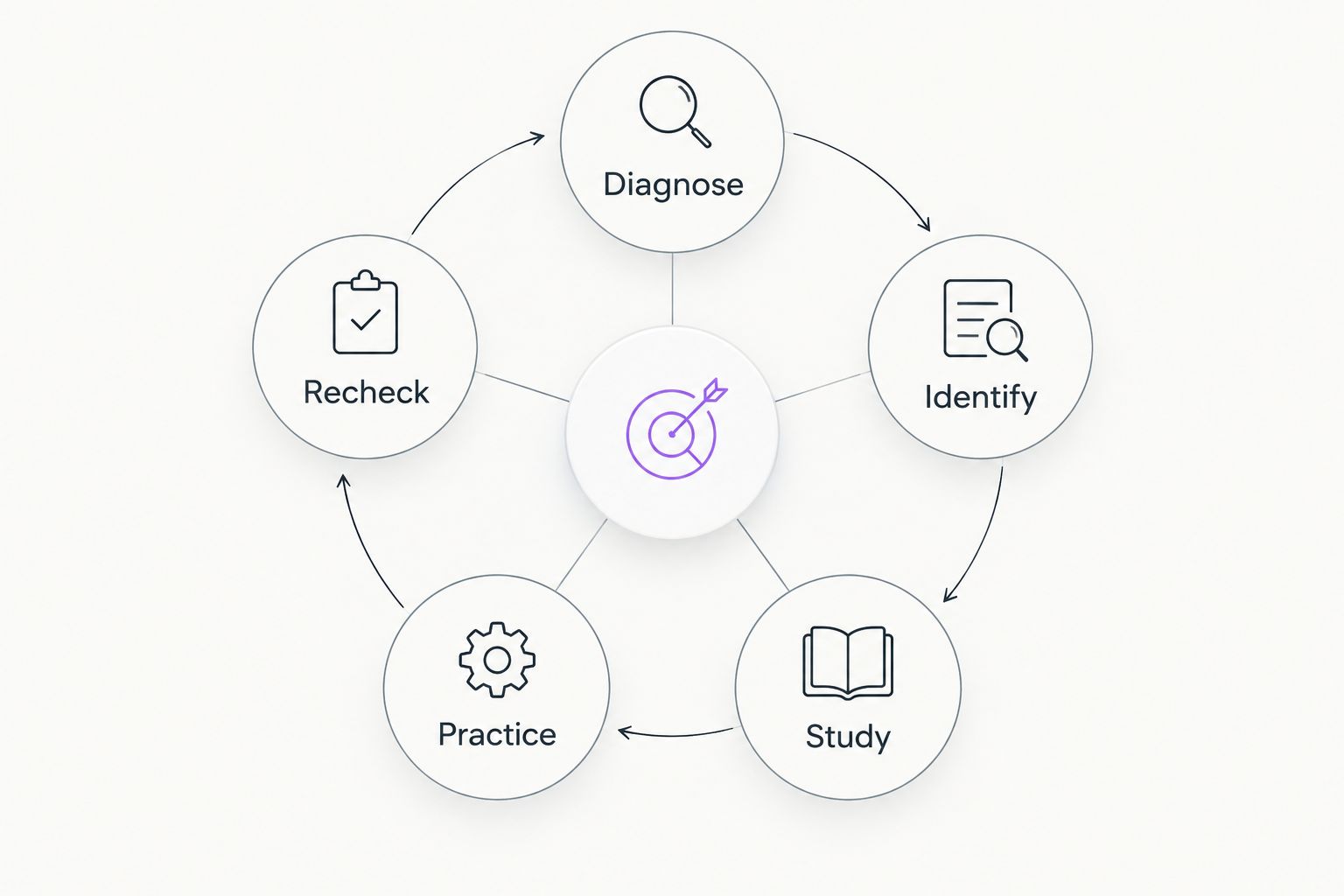
Turn your diagnostic into a study loop
Use this sequence after your first practice result. Keep the focus narrow enough that you can explain what changed between attempts.
- Diagnose: Complete the diagnostic independently.
- Identify: Choose a weak subtest and inspect its missed questions.
- Study: Review the specific concept behind those errors.
- Practice: Solve fresh questions without consulting the explanation.
- Recheck: Return to mixed or timed practice to assess application.
The loop ends in another assessment, not in finishing a chapter. If the same error returns, revisit the method rather than repeating the entire exam immediately.
Worked examples: find the error before adding speed
These teaching examples show how to review a mistake. They are not official ASVAB questions and do not predict your score.
Arithmetic Reasoning: convert a rate into a distance
Question: A vehicle travels 150 miles in 3 hours at a constant speed. How far does it travel in 5 hours at that speed?
- Find the hourly rate: 150 miles ÷ 3 hours = 50 miles per hour.
- Apply the rate: 50 miles per hour × 5 hours = 250 miles.
- Check the units: hours cancel, leaving miles.
Answer: 250 miles. The distance follows from the same hourly rate. Adding 2 miles because the trip lasts 2 additional hours confuses a time difference with a distance difference.
Mathematics Knowledge: use a common denominator
Question: What is 3/4 − 1/6?
- Choose 12 as a common denominator.
- Rewrite the fractions: 3/4 = 9/12 and 1/6 = 2/12.
- Subtract the numerators: 9/12 − 2/12 = 7/12.
Answer: 7/12. The denominator stays 12 because both quantities now use equal-sized parts. Subtracting denominators does not preserve that shared unit.
Word Knowledge: preserve the meaning
Question: Which word is closest in meaning to scarce: plentiful, limited, ordinary, or visible?
Answer: limited. Scarce means insufficient or not plentiful. “Plentiful” is the opposite; “ordinary” and “visible” describe different qualities.
If you missed this question, record the definition and the contrast with its opposite. Then answer a new vocabulary question rather than immediately repeating this one.
How these practice formats are ranked
The order follows the study task: establish a baseline, correct a weakness, then check performance under time limits. PDFs and flashcards support particular learning needs rather than replacing that sequence.
This is a format-based recommendation for 2026 preparation, not a claim of controlled testing, official approval, or measured score gains. Judge each resource against the criteria above and your actual errors.
Which ASVAB practice test should you choose?
Start with the free diagnostic. Choose targeted practice next if you uncover a subject weakness. Choose a timed full-length exam when you need to assess pacing after reviewing the material.
Do not mistake completing more tests for correcting more mistakes. Your next resource should answer a specific need: explanation, application, recall, or timing.
FAQ
What's the best ASVAB practice test for Army beginners?
A diagnostic is the best starting format for an Army beginner who does not know their weak subjects. Use the result to choose a subtest, then study the specific skills behind missed questions.
Is the Army ASVAB different from the regular ASVAB?
The Army uses the ASVAB, not a separate Army-only academic exam. Army qualification decisions use applicable score requirements, so a practice result alone does not establish eligibility.
Which ASVAB subjects count toward the AFQT?
The AFQT uses Arithmetic Reasoning, Mathematics Knowledge, Word Knowledge, and Paragraph Comprehension. Other ASVAB subtests also matter for military job qualification.
Should I take a full-length test every day?
Do not make daily full-length testing your default. Review errors and practice the underlying skills before taking another exam to assess progress.
Does a timed practice exam work exactly like CAT-ASVAB?
A timed practice exam is not automatically equivalent to CAT-ASVAB. CAT-ASVAB uses adaptive delivery, and practice timing alone does not reproduce its item selection or official scoring.
Are free diagnostic tests and paid PDFs the same thing?
No. A diagnostic establishes a starting point, while a PDF study guide or question bank provides material for learning or practice. Check each resource's contents rather than assuming shared access or features.
Can a practice score guarantee Army enlistment or a particular job?
No practice score guarantees Army enlistment or job qualification. Official testing and the Army's applicable requirements determine those outcomes.
One last thing
A correct answer can still hide a weakness. If you guessed, mark the question for review just as you would an incorrect answer. In your 2026 preparation, a method you can explain is more useful than an answer you happen to recognize.