

Best overall starting point: ASVAB Commander's free diagnostic. Best for word problems: Arithmetic Reasoning practice sets. Best for algebra and geometry: Mathematics Knowledge practice sets. This 2026 ASVAB math practice test guide compares five practice formats so you can identify your weakest subject before choosing your next exercise.
- Start with ASVAB Commander's free diagnostic, then focus study on your weakest math subtest.
- Choose an ASVAB math practice test that separates Arithmetic Reasoning from Mathematics Knowledge.
- Use focused drills to correct mistakes before taking another timed full-length practice exam.
- Choose paid PDFs for written practice, not as a substitute for reviewing incorrect answers.
Why this matters
ASVAB math is not one subject. Arithmetic Reasoning tests how you solve mathematical word problems. Mathematics Knowledge tests your knowledge of mathematical concepts and procedures. Both contribute to the AFQT, alongside Word Knowledge and Paragraph Comprehension.
That distinction determines what you should study. A recruit who understands equations but misreads rate problems needs different practice from someone who cannot isolate a variable. Repeating a general test without separating those weaknesses leaves the actual problem unresolved.
ASVAB Commander is the best starting point for first-time recruits who need a free diagnostic before choosing focused math practice. The recommendation is about study order, not a claim that one resource guarantees a higher score.
What makes the best ASVAB math practice test?
Use these criteria to choose your next test in 2026:
- Subtest relevance: Identify whether the questions address Arithmetic Reasoning, Mathematics Knowledge, or both. Do not treat every math error as the same weakness.
- Explained solutions: Look for steps that show the setup, calculation, and reason the answer is correct. An answer letter alone does not teach the method.
- Targeted practice: Choose questions that address the topic you missed, such as fractions, percentages, equations, or area.
- Appropriate timing: Use untimed work to repair a method. Use timed practice to check whether you can apply that method under a time limit.
- Useful review: Keep enough information to explain each error and solve a similar question without copying the previous solution.
A resource does not need every format to serve a useful purpose. It needs to match your current problem. Check the sample questions and explanations before paying for material you have not examined.
ASVAB math practice options at a glance
These are ranked practice formats, not five competing websites. Each format serves a different stage of preparation. The default order starts with diagnosis and ends with broader rehearsal or additional written practice.
| Rank and option | Best for | Standout use | Key limitation |
|---|---|---|---|
| 1. Free diagnostic | Finding your starting weakness | Establishes what needs review | Does not replace a focused lesson |
| 2. Arithmetic Reasoning sets | Translating word problems | Practices choosing the correct operation | Does not cover all Mathematics Knowledge topics |
| 3. Mathematics Knowledge sets | Repairing algebra and geometry skills | Isolates mathematical procedures | Does not replace word-problem practice |
| 4. Timed full-length practice exams | Rehearsing a broader test session | Adds pacing and subject changes | Makes individual weaknesses harder to isolate during the session |
| 5. PDF question banks | Working problems on paper | Supports written calculations and annotations | Requires you to track mistakes and progress |
1. Free diagnostic: best ASVAB math practice for finding weaknesses
Start with the ASVAB Commander free diagnostic before deciding that you need more algebra, more word problems, or another study guide. Use the questions you miss to identify what requires attention. A diagnostic is a starting measurement, not your entire study plan.
For your 2026 preparation, record the type of error as well as the topic. Getting a percentage question wrong because you chose the wrong base is different from setting it up correctly and multiplying incorrectly.
Free diagnostic pros:
- Gives your first study session a specific purpose.
- Helps you choose between word-problem and concept practice.
- Creates a starting record you can compare with later work.
Free diagnostic cons:
- Does not replace instruction on an unfamiliar topic.
- A correct guess can conceal a weakness unless you review it.
Best for: First-time recruits who do not know which math subject to study first.
After the diagnostic, write a short instruction for your next session: practice fraction division, translate distance problems, or solve equations with negative numbers. That is more useful than writing only that you need to improve math.
Verdict: Hold off on another general test until you have reviewed the diagnostic mistakes.
2. Arithmetic Reasoning sets: best for word-problem mistakes
Arithmetic Reasoning practice belongs next when the story causes more trouble than the calculation. These questions ask you to translate information into a mathematical relationship. Focus on the setup before trying to work faster.
Choose a set organized around your weak topic when possible. Mixing every kind of word problem immediately makes it harder to see whether you have corrected a particular misunderstanding.
Worked example: distance and time
A vehicle travels 150 miles in 3 hours at a constant speed. How far does it travel in 5 hours at that same speed?
- Find the rate: Divide 150 miles by 3 hours to get 50 miles per hour.
- Apply the rate: Multiply 50 miles per hour by 5 hours to get 250 miles.
- Check the result: Five hours is longer than three hours, so the distance must exceed 150 miles.
The answer is 250 miles. Dividing 150 by 5 would use the requested travel time to calculate a different rate. The question says the speed stays the same, so calculate that speed from the original information first.
Arithmetic Reasoning sets pros:
- Isolate the translation from words to equations.
- Support repeated practice on one problem type.
- Make units useful for checking your setup.
Arithmetic Reasoning sets cons:
- Do not cover the full Mathematics Knowledge syllabus.
- Repeating nearly identical questions can reward memorization rather than understanding.
Best for: Recruits who can calculate but struggle to decide what a word problem requires.
Verdict: Skip mixed-topic speed drills until you can explain the setup of your weak problem type.
3. Mathematics Knowledge sets: best for algebra and geometry gaps
Mathematics Knowledge practice belongs next when you recognize the task but cannot execute the mathematical procedure. Examples include solving an equation, applying exponent rules, or choosing the correct area formula.
For 2026 study, work on the rule that caused the error rather than repeating an entire math section. Keep your written steps. They show whether the mistake happened during setup, sign handling, or calculation.
Worked example: solve an equation
Solve 3x + 7 = 22.
- Subtract 7 from both sides: This leaves 3x = 15.
- Divide both sides by 3: This leaves x = 5.
- Substitute to check: Three times 5, plus 7, equals 22.
The answer is x = 5. Subtracting 7 from only one side changes the equation instead of preserving equality. Dividing 22 by 3 immediately also fails to remove the added 7 first.
Practice question: area or perimeter?
A rectangle is 8 feet long and 5 feet wide. What is its area?
Multiply length by width: 8 feet times 5 feet equals 40 square feet. Area measures the surface inside the rectangle. Adding all four sides gives 26 feet, which is the perimeter, not the area.
Mathematics Knowledge sets pros:
- Isolate specific procedures and formulas.
- Let you inspect each written step.
- Make it easier to distinguish a concept gap from arithmetic carelessness.
Mathematics Knowledge sets cons:
- Do not replace Arithmetic Reasoning preparation.
- Familiar exercises become less useful if you recall answers without solving them.
Best for: Recruits whose errors involve algebra rules, geometry formulas, or mathematical procedures.
Verdict: Hold off on harder questions until you can solve and check the current procedure independently.
4. Timed full-length practice exams: best for pacing rehearsal
Use a timed full-length practice exam after reviewing your main subject weaknesses. ASVAB Commander provides timed full-length practice exams, but a practice exam is not the official CAT-ASVAB. Do not assume that practice reproduces the official adaptive testing system.
A broader timed session asks a different question from a focused drill: can you apply what you know while managing time and changing subjects? Review the result by subject afterward. A single total does not explain why a math question went wrong.
Timed full-length practice exam pros:
- Adds a time limit to your preparation.
- Includes practice beyond an isolated math topic.
- Provides a reason to examine pacing alongside accuracy.
Timed full-length practice exam cons:
- Requires a longer study session than a focused exercise.
- Does not teach an unfamiliar method while you are testing.
- An overall result can distract you from a specific math weakness.
Best for: Recruits who understand their weak topics and now need timed rehearsal.
Mark correct guesses for review too. Finishing a question successfully does not prove that you can repeat the method if you selected the answer without understanding it.
Verdict: Hold full-length rehearsal until you have corrected the errors identified in focused practice.
5. PDF question banks: best for written practice
A PDF question bank fits recruits who want to write calculations, annotate questions, and revisit selected problems. Paid PDF study guides and question banks are separate resources from the free diagnostic. Do not assume that a PDF purchase and a membership include the same material.
Choose a study guide when you need instruction. Choose a question bank when you need additional exercises, after checking its coverage and sample explanations. The format alone does not establish the quality of its teaching.
PDF question bank pros:
- Supports handwritten setups and calculations.
- Lets you annotate why a particular answer was wrong.
- Keeps selected exercises together for later review.
PDF question bank cons:
- Requires you to maintain your own error record.
- Reworking a familiar page can test answer recall instead of understanding.
Best for: Recruits who prefer working through questions on paper.
Use a separate sheet for solutions if you plan to revisit the questions. That keeps your previous calculations from giving away the next attempt.
Verdict: Buy only after checking that the PDF addresses the subject you need to improve.
How to turn a practice result into a study session
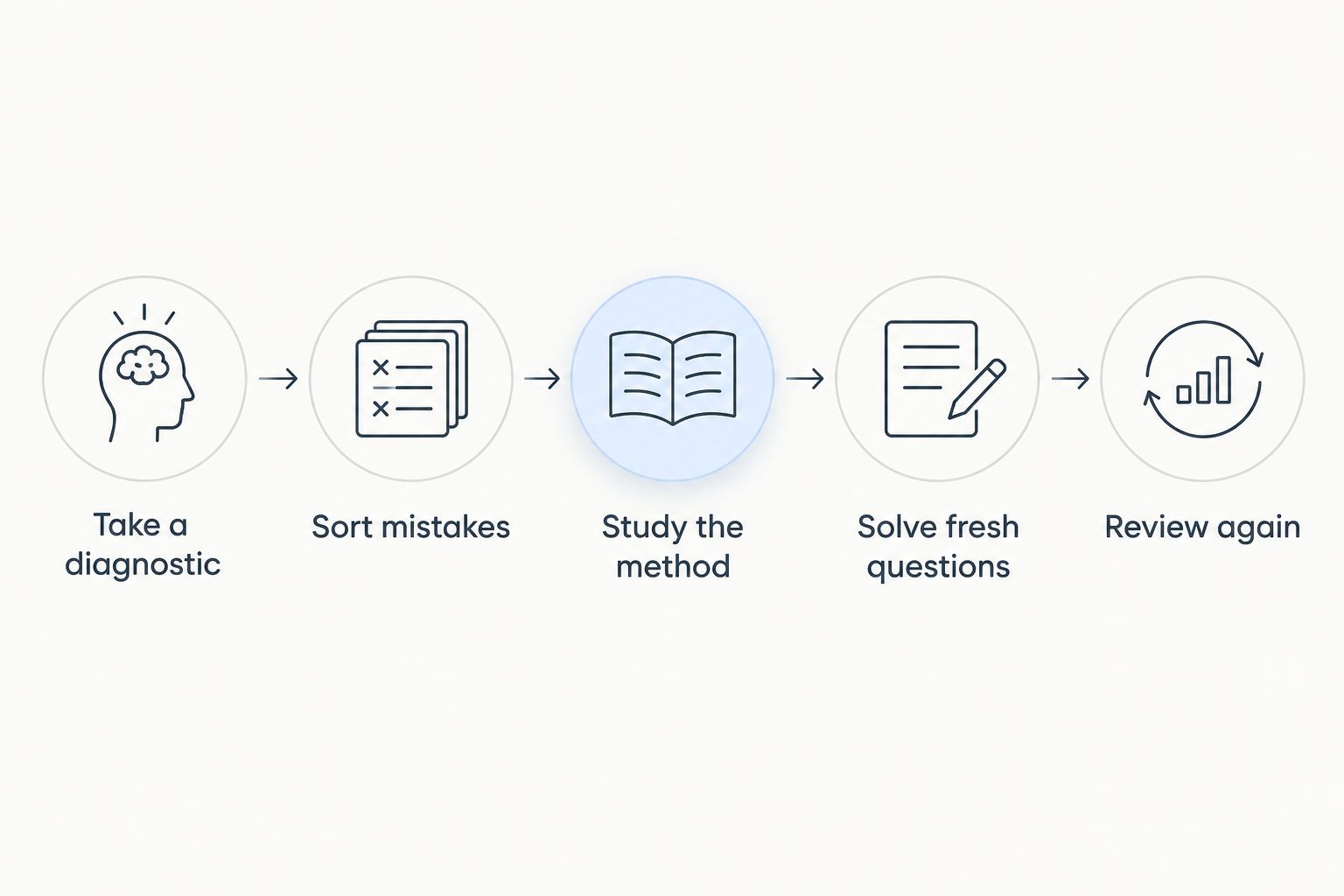
Use this sequence throughout your 2026 preparation. Keep the record simple enough that you will actually maintain it.
- Take a diagnostic: Answer independently so the result reflects your current understanding.
- Sort mistakes: Separate word-problem setup, mathematical procedure, calculation, and timing errors.
- Study the method: Work through an explanation and identify why the incorrect approach failed.
- Solve fresh questions: Apply the method without looking at the example.
- Review again: Check whether you can explain the method, not just recognize an answer.
The sequence keeps testing from replacing learning. Return to a lesson when you cannot explain a step; return to timed practice when the method is clear but pacing remains a problem.
Paid membership is $9.99/month. Consider it only after the free diagnostic has helped you define your study need; check the current membership inclusions and renewal terms before subscribing. Do not assume that every practice resource or paid PDF is included.
How the options were ranked
The ranking follows the study task: diagnose, repair word-problem or procedural weaknesses, rehearse under time, then add written material when it serves a specific need. The criteria are subtest relevance, explained solutions, targeted practice, appropriate timing, and useful review.
This is a selection framework, not a score-gain study or a claim that every resource has been independently tested. No practice format guarantees an AFQT result, enlistment eligibility, or a military job.
Which ASVAB math practice test should you choose?
Choose the free diagnostic first if you are undecided. Then choose Arithmetic Reasoning sets for translation errors or Mathematics Knowledge sets for procedural gaps. Move to timed full-length practice after you can solve your weak question types without copying a solution.
The best 2026 choice is the format that answers your next study question. More questions are not a substitute for understanding why the previous answer was wrong.
FAQ
What's the best ASVAB math practice test for a beginner?
ASVAB Commander's free diagnostic is the recommended starting point for a beginner. Use the questions you miss to choose focused Arithmetic Reasoning or Mathematics Knowledge practice next.
What is the difference between Arithmetic Reasoning and Mathematics Knowledge?
Arithmetic Reasoning focuses on solving mathematical word problems, while Mathematics Knowledge tests mathematical concepts and procedures. Separate the two when reviewing mistakes so you study the skill that caused the error.
Do both ASVAB math subtests count toward the AFQT?
Yes. Arithmetic Reasoning and Mathematics Knowledge contribute to the AFQT, along with Word Knowledge and Paragraph Comprehension. Improving math preparation does not remove the need to prepare for the verbal subtests.
Should I take timed or untimed ASVAB math practice?
Use untimed practice to learn or correct a method, then use timed practice to check pacing. If you cannot explain the solution without a timer, return to instruction before adding time pressure.
Can I use a calculator on the ASVAB?
No. Calculators are not permitted on the ASVAB. Practice the arithmetic steps by hand so your preparation matches that requirement.
Is a practice test the same as the CAT-ASVAB?
No. A practice test is preparation, while the CAT-ASVAB is an official computer-adaptive test. Do not assume that a timed practice exam reproduces official adaptive question selection or score reporting.
Is a PDF question bank better than a full-length practice test?
A PDF question bank is better suited to written exercises and annotations; a timed full-length practice test serves broader rehearsal. Choose according to your current weakness rather than treating either format as a complete study plan.
One last thing
Review correct guesses before celebrating a clean answer sheet. A guessed answer and a solved answer look identical when marked correct, but only the solved answer shows a method you can use again. Explain the setup aloud, then try a fresh question.